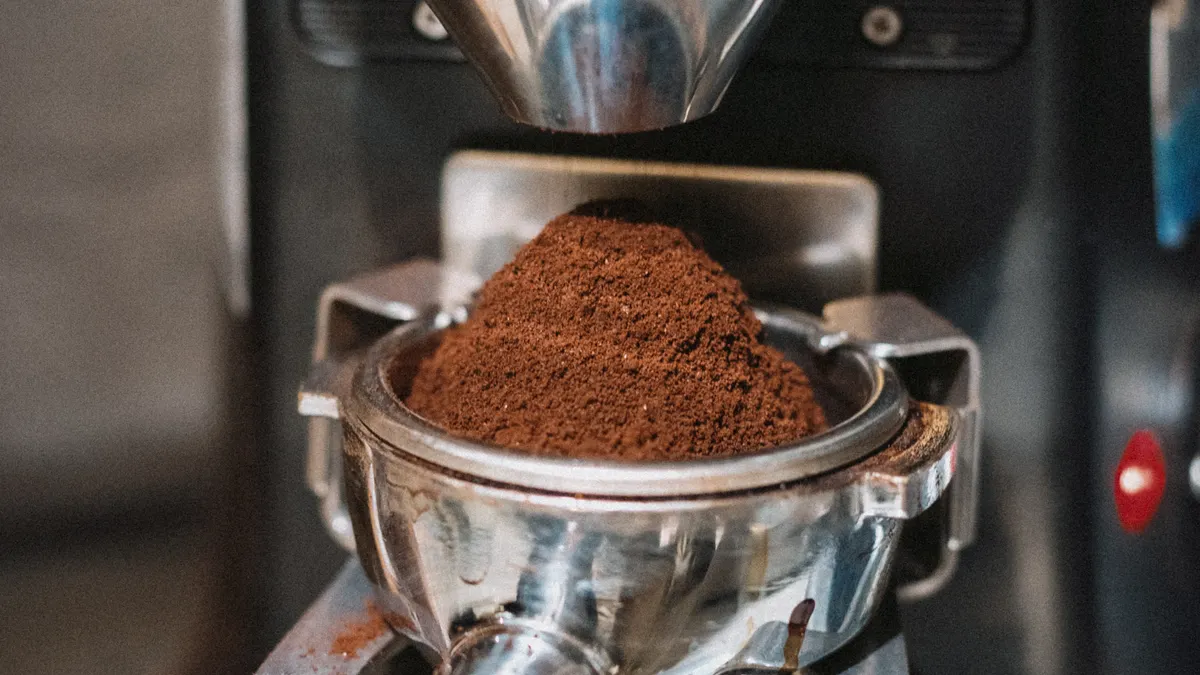
Cuando alguien me escribe porque su espresso sale amargo un día y agrio al siguiente, casi siempre pregunto lo mismo antes de hablar de la máquina: ¿con qué estás moliendo? En la mayoría de los casos, el problema no está en la cafetera. Está en el molino.
Y en esta época del año la pregunta se multiplica, porque entre Black Friday y Navidad mucha gente en Houston y Katy está por comprar uno, para sí o para regalar. Así que vamos a lo práctico: qué mirar, qué ignorar y dónde se equivoca la mayoría.
Primero: cuchillas no, muelas sí
Los molinos de cuchillas (los de botón, que parecen una licuadora pequeña) no muelen: cortan. La cuchilla gira y pica el grano al azar, así que en la misma tanda terminas con polvo fino y pedazos grandes. El polvo se sobreextrae y da amargor; los pedazos grandes se quedan cortos y dan acidez agria. Por eso ese café sabe a las dos cosas a la vez.
Un molino de muelas (burr grinder) hace pasar el grano entre dos piezas con una separación fija. Cada partícula sale de ese mismo espacio, así que el tamaño es mucho más parejo. Si cambias la separación, cambias la molienda de forma controlada. Ese control es lo que te deja corregir una taza en vez de adivinar.
Si hoy tienes uno de cuchillas, no te sientas mal: casi todos empezamos así. Pero es el cambio que más se nota en la taza, más que cambiar de cafetera.
Pregúntate primero cómo preparas tu café
Esta es la decisión que más importa, y la que más gente se salta. Un molino excelente para filtrado puede ser inútil para espresso, y al revés.
- Si haces filtrado (V60, Chemex, prensa francesa, cafetera de goteo): necesitas una molienda media o gruesa y pareja. Aquí tienes muchas opciones buenas y a precios razonables, incluidos molinos manuales.
- Si haces espresso: necesitas moler muy fino y, sobre todo, poder hacer ajustes muy pequeños. El espresso reacciona a cambios mínimos de molienda; un paso de más y el shot pasa de correr bien a ahogarse. Muchos molinos pensados para filtrado sencillamente no llegan a esa finura, o saltan de un punto a otro sin término medio.
- Si haces las dos cosas: busca uno que cubra ambos rangos y que no sea un dolor de cabeza volver de grueso a fino. Algunos lo resuelven bien; otros te obligan a recalibrar desde cero cada vez.
Ajuste por pasos o sin pasos
Los molinos por pasos tienen posiciones fijas: haces clic de un número al siguiente. Son fáciles de repetir, y para filtrado suelen bastar. Para espresso, lo que importa es qué tan cerca están esos pasos entre sí. Si son pocos y muy separados, vas a quedar atrapado entre "muy rápido" y "muy lento".
Los molinos sin pasos (stepless) te dejan ajustar de forma continua, a cualquier punto intermedio. Dan más precisión para espresso, pero exigen que anotes o marques dónde estás, porque volver al mismo punto no es tan obvio.
Mi regla: para espresso, sin pasos o con pasos muy finos. Para filtrado, por pasos está perfecto.
Muelas cónicas o planas
Aquí hay mucho ruido en internet. Lo resumo en lo que sí sirve para decidir en casa:
- Cónicas: son las más comunes en molinos domésticos, suelen trabajar a menos revoluciones, retienen menos café adentro y tienden a ser más baratas. Muchos baristas las consideran más tolerantes al calibrar.
- Planas: producen un tamaño de partícula más uniforme, y mucha gente percibe tazas con más claridad, sobre todo en cafés claros. A cambio, suelen ser más caras, más ruidosas y retener más café, aunque el diseño de cada molino cambia mucho eso.
Para alguien que empieza, la forma de la muela importa menos que la calidad del molino en general. Un buen molino cónico le gana a un mal molino plano.
Retención: el detalle que nadie revisa
La retención es el café molido que se queda atrapado dentro del molino después de cada uso. En la siguiente molienda, ese café viejo sale mezclado con el nuevo. Para filtrado es un detalle menor; para espresso, donde pesas al décimo de gramo, sí afecta.
Por eso muchos en casa muelen "dosis por dosis" (single dosing): pesan el café de cada preparación y lo muelen completo, sin dejar granos en la tolva. Aquí en Houston tiene una ventaja extra: la tolva no es hermética, y dejar granos ahí varios días con nuestra humedad es lo mismo que dejarlos fuera de la bolsa. Lo explico más en cómo guardar el café en Houston.
Manual o eléctrico
Un molino manual bueno puede dar una molienda mejor que un eléctrico de precio parecido, porque todo el dinero se va en las muelas y no en el motor. Para una o dos tazas de filtrado al día es una gran compra, y también un buen regalo. Hay manuales capaces de moler para espresso, pero moler fino a mano todos los días cansa. Si haces varios espressos diarios o preparas para más gente, el eléctrico te va a ahorrar paciencia.
Si lo vas a regalar
Antes de comprar, averigua una sola cosa: cómo prepara café esa persona. Un molino de espresso para alguien que solo usa prensa francesa es dinero mal gastado, y al revés es peor. Si no puedes preguntar sin arruinar la sorpresa, un buen manual para filtrado es la opción más segura.
Dónde poner el dinero
Si tu presupuesto es limitado y quieres espresso, mi consejo es invertir primero en el molino y después en la máquina. Una máquina modesta con un buen molino da mejores shots que una máquina cara con un molino que no puede ajustar fino. El molino es lo que te deja calibrar; sin eso, la máquina no tiene con qué trabajar.
Y una advertencia honesta: un buen molino no calibra solo. Te da la herramienta, pero hay que aprender a leer el shot y saber hacia dónde mover el ajuste. Ese es el paso que más gente se salta, y el que más cambia la taza.
When someone messages me because their espresso tastes bitter one day and sour the next, I ask the same question before we ever talk about the machine: what are you grinding with? Most of the time the problem isn't the espresso maker. It's the grinder.
This time of year the question comes up a lot, because between Black Friday and the holidays plenty of people in Houston and Katy are about to buy one, for themselves or as a gift. So let's keep it practical: what to look at, what to ignore, and where most people get it wrong.
First: skip the blades, get burrs
Blade grinders (the push-button kind that look like a tiny blender) don't grind, they chop. The blade spins and hits the beans at random, so a single batch ends up with dust and big chunks. The dust over-extracts and turns bitter; the chunks under-extract and taste sour. That's why the cup tastes like both at once.
A burr grinder pushes the beans between two burrs set at a fixed gap. Every particle leaves through that same gap, so the size is far more consistent. Change the gap and you change the grind in a controlled way. That control is what lets you fix a cup instead of guessing.
If you own a blade grinder today, no shame, most of us started there. But it's the upgrade you'll taste the most, more than a new brewer.
Start with how you brew
This is the decision that matters most, and the one most people skip. A great filter grinder can be useless for espresso, and vice versa.
- Filter coffee (V60, Chemex, French press, drip machine): you need an even medium-to-coarse grind. There are plenty of solid, reasonably priced options here, hand grinders included.
- Espresso: you need to grind very fine and, above all, make tiny adjustments. Espresso reacts to the smallest grind change; one notch too far and a good shot chokes. Many filter grinders simply can't go that fine, or jump between settings with nothing in between.
- Both: look for a grinder that covers both ranges and doesn't make switching from coarse to fine a chore. Some handle it well; others make you re-dial from scratch every time.
Stepped or stepless
Stepped grinders click between fixed settings. They're easy to repeat and usually fine for filter. For espresso, what matters is how close those steps are. Too few, too far apart, and you'll be stuck between "too fast" and "too slow."
Stepless grinders adjust continuously, to any point in between. They give you more precision for espresso, but you'll want to mark or note your setting, because getting back to the same spot isn't obvious.
My rule of thumb: for espresso, stepless or very fine steps. For filter, stepped is perfectly fine.
Conical or flat burrs
There's a lot of noise about this online. Here's what actually helps you decide for a home setup:
- Conical: the most common in home grinders. They usually run at lower RPM, retain less coffee and tend to cost less. Many baristas find them more forgiving when dialing in.
- Flat: a more uniform particle size, and many people taste more clarity in the cup, especially with light roasts. The trade-off: usually pricier, louder and with more retention, though each grinder's design changes that a lot.
If you're just starting out, burr shape matters less than the overall quality of the grinder. A good conical beats a poor flat every time.
Retention: the spec nobody checks
Retention is the ground coffee that stays trapped inside the grinder after each use. Next time you grind, that stale coffee comes out mixed with the fresh. For filter it's minor; for espresso, where you're weighing to a tenth of a gram, it shows.
That's why many home baristas single dose: weigh the beans for each brew and grind all of them, leaving nothing in the hopper. In Houston there's a bonus: hoppers aren't airtight, and leaving beans in one for days in our humidity is like leaving the bag open. More on that in how to store coffee beans in Houston.
Hand or electric
A good hand grinder can out-grind an electric one at a similar price, because all the money goes into the burrs instead of a motor. For one or two filter cups a day it's a great buy, and a great gift. Some hand grinders can handle espresso, but grinding fine by hand every morning gets old. If you pull several shots a day or brew for a household, an electric grinder will save your patience.
Buying one as a gift
Find out one thing first: how that person brews. An espresso grinder for someone who only uses a French press is wasted money, and the reverse is worse. If you can't ask without spoiling the surprise, a good hand grinder for filter is the safest bet.
Where to put your money
If your budget is tight and you want espresso, my advice is grinder first, machine second. A modest machine with a good grinder pulls better shots than an expensive machine with a grinder that can't adjust fine enough. The grinder is what lets you dial in; without it, the machine has nothing to work with.
One honest caveat: a good grinder won't dial itself in. It gives you the tool, but you still have to learn to read a shot and know which way to move the setting. That's the step most people skip, and the one that changes the cup the most.